
Atreyee Ghosh, Senior Manager-Technical, IITI DRISHTI CPS Foundation
Sandeep Semwal, Research Associate, IITI DRISHTI CPS Foundation
The revolutionary shift towards precision medicine is being spearheaded by the introduction of Digital Twin (DT) technology. As the need for and value of DT grows, the healthcare DT market’s revenue is projected to soar from $1.6 billion in 2023 to $21.1 billion by 2028 [1]. Human DT, Equipment DT, and Hospital DT are the three main areas where DT studies are conducted in the healthcare industry. In this article, we offer a brief overview of the research conducted on Human DT.
Researchers have worked on developing DT for the complete human body, isolated body systems or functions (such as the digestive system), for specific organs (like the liver and heart), and even at smaller levels like cells and subcellular components (organelles or sub-organelles). Molecular structures and individual diseases or disorders were considered in certain studies to construct disease transmission (DT) models of the human immune system. Then, these models can be utilised for diagnosis and individualised treatment plans, even surgery. DTs play an important role by guiding surgeons in real time during the operation itself. The improved situational awareness that results from following these recommendations facilitates better surgical outcomes. Some of the DT based surgical interventions include DT framework for liver tumor surgery, pre-operative planning and surgical training, remote surgery, skull base surgery, cancer treatment, orthopedic surgery, heart surgery. Drug discovery, drug testing, and personalised medicine are all areas where DT finds use. In addition, the research highlights the use of DT in conjunction with AR and VR for surgical guiding by superimposing pre-operative images onto the anatomy of the patients.

Despite challenges in data collection, fusion, and simulation, the DT is expected to gain increasing use in personal health management and healthcare services, aiding in the creation of high-resolution patient models for precise diagnosis and personalized treatment. As technology continues to evolve, the integration of digital twins into health- care systems will undoubtedly shape the future of medicine and improve patient outcomes.
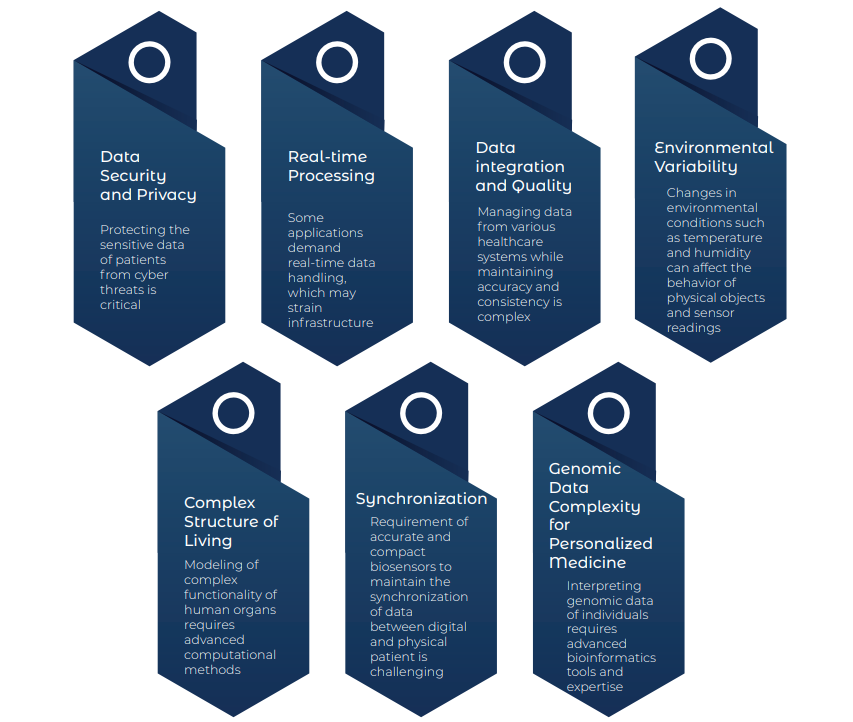
Challenges with DTs in Healthcare
REFERENCES
- Digital-twins-in-healthcare-market, Markets and Markets Research Pvt. Ltd, June 2023
- Alasmari W.A., (2021), Medical students’ feedback of applying the virtual dissection table (Anatomage) in learning anatomy: a cross-sectional descriptive study, Advances in Medical Education and Practice, 1303-1307
- Moretta F., Rizzo E., Manenti F., Bozzano G., (2021), Enhancement of anaerobic digestion digital twin through aerobic simulation and kinetic optimization for co-digestion scenarios, Bioresource Technology, 341, 125845
- Subramanian K., (2020), Digital twin for drug discov- ery and development—The virtual liver, J. Indian Inst. Sci., 100, 653–662
- Yao , Chen S., and Guccione J. M., (2022), A Com- putationally Efficient Approach to Simulate Heart Rate Effects Using a Whole Human Heart Model, Bioengineering (Basel, Switzerland), 9, 334.
- Li X., Lee E.J., Lilja S., Loscalzo J., Schäfer S., Smelik M., Strobl M.R., Sysoev O., Wang H., Zhang H., Zhao Y., (2022), A dynamic single cell-based framework for digital twins to prioritize disease genes and drug targets, Genome Medicine, 14, 1-21
- McMahon-Cole H., Johnson A., Aghamiri S.S., He- likar T., Crawford L.B., (2023), Modeling and Remodeling the Cell: How Digital Twins and HCMV Can Elucidate the Complex Interactions of Viral Latency, Epigenetic Regulation, and Immune Responses, Current Clinical Microbiology Reports, 10, 141-151.
- Digital Twins in Healthcare: Innovations and Applications, Daffodil, June 9,
- Shi , Deng X., Tong Y., Li R., Zhang Y., Ren L., Si W., (2022), Synergistic digital twin and holographic augmented-reality-guided percutaneous puncture of respiratory liver tumor, IEEE Transactions on Human-Machine Systems, 52, 1364– 1374.
- Shu H., Liang R., Li Z., Goodridge A., Zhang X., Ding , Nagururu N., Sahu M., Creighton F.X., Taylor R.H., Munawar A., (2023), Twin-S: A digital twin for skull base surgery, International Journal of Computer Assisted Radiology and Surgery, 18, 1077-1084.
- Jamshidi M.B., Ebadpour M., Moghani M.M, (2022), Cancer digital twins in metaverse, 20th International Conference on Mechatronics-Mechatronika (ME), 1-6.
- Aubert K, Germaneau A., Rochette M., Ye W, Sev- eryns M., Billot M., Rigoard P., Vendeuvre T., (2021), Development of digital twins to optimize trauma surgery and postoperative management, A case study focusing on tibial plateau fracture, Frontiers in Bioengineering and Biotechnology, 9,
- Houten H. V., How a virtual heart could save your real one, Philips, Nov 12,
- An G., Cockrell C., (2022), Drug development digital twins for drug discovery, testing and repurposing: a schema for requirements and development, Frontiers in systems biology, 2,
- Björnsson B., Borrebaeck C., Elander N., Gasslander , Gawel D.R., Gustafsson M., Jörnsten R., Lee E.J., Li X., Lil- ja S., Martínez-Enguita D., (2020), Digital twins to personalize medicine, Genome medicine, 12, 1-4.